
⋅ X min read
Benefits represent nearly 30% of everything companies spend on their people. And yet only 44% of employees feel they have a good understanding of the health and wellbeing benefits available to them — and employee satisfaction with benefit offerings has actually fallen, from 66% to 61%, in the past year alone (WTW EX Intelligence).
That gap is not a benefits problem. It's a communications problem, and it has a fix.
This playbook sets out the principles and practical steps benefits teams can use to close it, drawing on the disciplines marketers apply every day: audience insight, clear goals, the right channel at the right time, and a comms strategy that doesn't stop at launch.
The problem with how benefits get communicated
Most benefits comms starts life as a project task, not a communications strategy. The benefits team spends months on procurement, implementation, and stakeholder sign-off. Comms gets four weeks. By the time anyone asks how employees will actually hear about this, the launch is already booked.
The result is front-loaded, transactional communication. An all-staff email on day one. A page buried in the intranet. A staff handbook that nobody reads after their first week.
Research from GRiD found that organisations use four channels on average to communicate benefits — the most common being welcome packs, day-one briefings, and staff handbooks — all passive, all front-loaded, and yet the message still isn't getting through. A further 18% of UK employers leave it entirely to employees to initiate uptake of their own benefits.
Verity Cash, a communications practitioner who has spent over two decades helping organisations navigate exactly this challenge, puts it plainly:
"The classic mistake — and I've done this myself working in-house — is you're thinking system first. You're not thinking people first. You're thinking: how do I make sure everyone can log on on day one? How am I making sure that I'm surfacing all of the benefits I've got in this new piece of kit? And actually, comms just gets lost."
It's not that comms people don't care. They do. They're simply brought in too late.
"Comms are brought in probably too late to the table. We're not there when the business decision is being made, when the contract's being signed. We're probably going to be brought in four weeks before it launches. So we're running to catch up. Then comms becomes transactional. You don't have time to think about personas or storytelling or use case scenarios. You're just running to get to that launch."
Part of the reason is timing. Most benefits communications is built around the launch moment, not the moments when benefits actually matter to someone. A new parent wants to know about parental leave when they find out they're expecting, not when they joined. Someone struggling with the cost of living wants to know about the discount card when they're feeling the pressure.
Part of the reason is uniformity. Workforces are multi-generational, multi-location, and increasingly mixed between office workers and those on the shop floor, in vans, or in warehouses with no company email and no desk. A single email blast treats everyone the same. The people it needs to reach most are often the ones it misses entirely.
It's telling that 34% of UK employers themselves believe their staff are unaware of or don't understand the benefits on offer — the problem isn't invisible to HR teams. It just isn't being fixed.
"Some colleagues simply can't access their benefits. They've got no idea what's available to them. They're out in vans all day. They don't have email access or desktop access. So we're already putting blockers in place to allow them to find out, let alone to wax lyrical about how great the benefits are."
The shift in mindset is straightforward. Before asking 'how do we get employees onto the platform?', ask 'what do our people actually need to know, and when do they need to know it?'
What a marketing approach looks like
Marketers don't launch products into a void. They define an audience, set a clear goal, choose the right channel, build a message that connects, and measure what happens next. Then they iterate.
The same logic applies to benefits communications, and it works.
Define your goal before you define your message
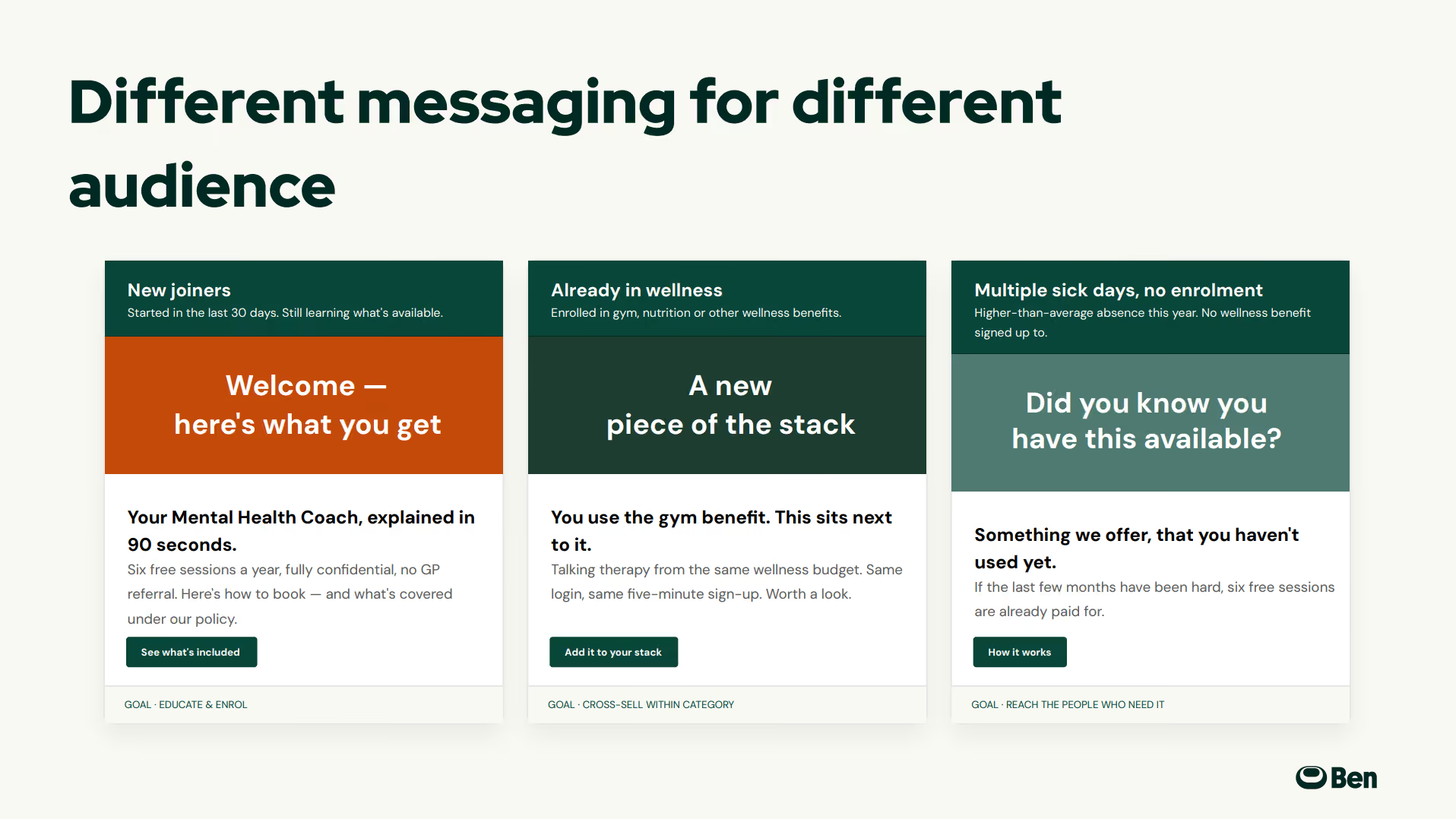
Not all benefits comms has the same job. Some is about awareness. Some is about action. Some is about trust. Clarity on the goal changes everything downstream.
Lauren Smith, lifecycle marketing manager at Ben, frames it this way:
"The best and most impactful campaign starts with: what am I trying to achieve with this, and how can I work backwards from there? If you're launching a new parental leave policy, for example, your goal might be to make everyone with dependants aware of it. Once you’ve got clarity on the goal, you think about the next step from there."
Know your audience before you build your message
Most benefits teams have more audience data than they realise. HR systems hold demographics, life stage indicators, location, and employment type. That data is the foundation of a segmented comms strategy.
Verity puts it directly:
"The HR team will have that information. It's our job as communicators to ask those questions. What are the demographics? What percentage of our colleagues are either in an office, driving a van, on a shop floor? What's the age range? How many colleagues make use of childcare vouchers, for example? Then you can plan your comms in the right way that suits your audience."
Personas are a useful tool here, even rough ones. A new starter in their twenties needs different information, delivered in a different way, than a 45-year-old with dependents who has been at the company for a decade. Building two or three audience profiles and thinking through their likely questions is enough to improve the relevance of almost any benefits communication.
The data supports the investment: 49% of employees say personalised benefit recommendations would increase their confidence in making benefits decisions, and employees who receive personalised guidance are nearly twice as likely to feel prepared for retirement — 81% versus 47%. Personalisation isn't a nice-to-have. It's what makes the difference between information and action.
Use the right channel, not the easiest one
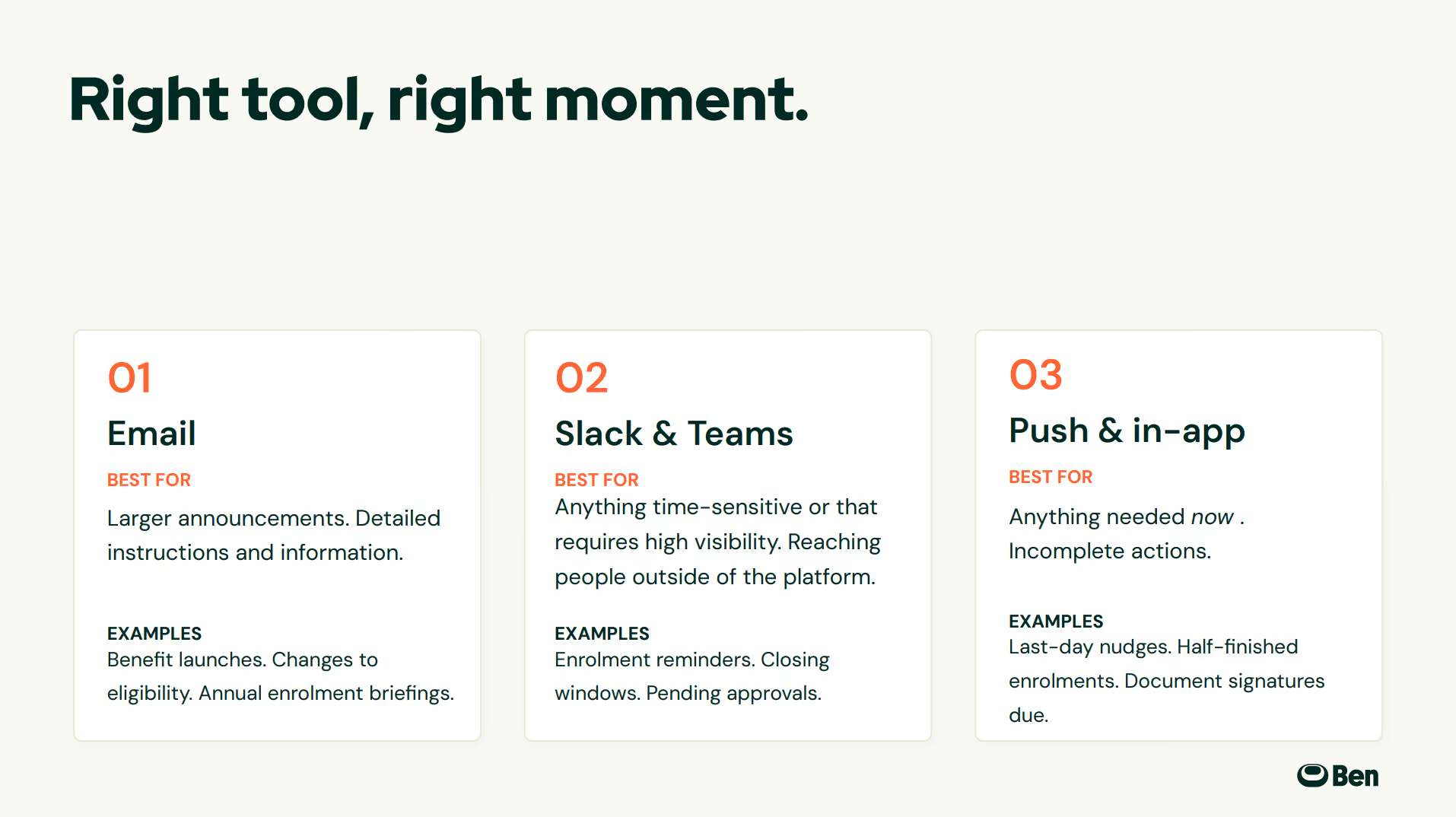
Email defaults dominate benefits communications because email is familiar and measurable. It serves a purpose, particularly for initial announcements to desk-based employees. But it's not enough on its own, and for some parts of the workforce, it barely registers.
For employees without desks, reaching them means going where they actually are. Lauren:
"A lot of people tend to default to email because it's easy, it's always there. But if you're trying to reach the hard-to-reach places, you need to start thinking about getting them where they actually work. If you know that you have desk-less employees but they might have access to something like Slack or Teams on their mobile device, then that's probably a good place to send a message. And even thinking about integrating it into your company systems — if you can see that a number of desk-less employees haven't engaged with a benefit, setting up a system that sends a notification to their line managers to bring it up in the next one-to-one."
Verity adds a point that's easy to overlook:
"As comms people, we like to build new things, new emails, new templates, new pages. Actually, particularly for those deskless workers, it's considering the meetings, the places, the opportunities they are already involved in. A Monday morning get-together, a one-to-one in the week. Consider those meetings that you need to be in, that your message needs to be in. They might not check their email for 10, 12 days at a time, and then you've lost them."
Build the message around 'what's in it for me?'
Benefits communications defaults to listing what's available. Here are your benefits. Here's the link. Log in and explore. That's not a message. It's a catalogue.
Verity describes what good storytelling looks like:
"It's moving from 'here are your benefits' to 'here's how we as a business support you and your wellbeing.' Going to find colleagues that are already using those benefits and finding them useful. Could you do video? Could you do some photography? Could you just get some quotes? 'I've saved myself X amount of money by using this.' The 'did you know' format works really well. Real people, real life scenarios, authentic stories."
At Ben, this plays out through a Slack channel where employees share what they've spent their flexible allowance on each month — language courses, art classes, sports equipment. Nikki Stones, VP of Marketing at Ben:
"It's really nice to then see how people are doing that. And of course, some benefits can be truly life-changing. Getting those stories, and sharing them if people are comfortable doing it, is great."
The three-phase comms structure
Every benefits comms plan should be structured in three phases: pre-launch, launch, and post-launch. Most plans get the first two somewhat right. Almost everyone underinvests in the third.
Pre-launch: create anticipation, not admin
Let employees know something's coming. If there are actions they need to take before go-live, this is when to prompt them. Brief line managers who will carry the message to desk-less populations. A manager who knows what's happening and why is far more useful than one who gets the all-staff email at the same time as everyone else.
Launch: make it meaningful, not just big
Lead with relevance and impact, not features. What's changing for people? What can they now do that they couldn't before? Segment where you can. Set a clear, specific call to action — not 'go and explore your benefits', but 'log in and check your flexible allowance balance' or 'review your protection cover before the window closes on Friday'. Specificity drives action.
Post-launch: where the real work begins
This is the phase that most benefits communications plans treat as optional. It isn't.
Verity:
"I think it's really easy to do those first two stages because you understand you need to get people aware and you need to get people on. But where you need to put the majority of your effort is post-launch and maintenance. Where I've seen this work really well is that the drip, drip of communication afterwards continues, and it's thought through, and it's using data, and it's using the insight that's all there in your system for you."
Data is your guide. Low utilisation of a benefit doesn't necessarily mean employees don't want it. It often means they don't know about it, they forgot, or they don't understand how to access it. A targeted, timely reminder is usually enough to move the dial.
A content calendar built around seasonal moments and life-stage triggers is one of the most practical tools available to a lean benefits team. Back to school, new year, key benefit renewal windows, mental health awareness weeks, financial wellbeing moments.
Verity:
"In the UK we love a seasonal day. Really simple comms. Actually, it might feel quite basic, but if you are someone that doesn't sit at a desk all day — maybe you're on the shop floor, in a warehouse, in a factory — that reminder about maybe it's Christmas savings, maybe it's going back to school, did you know we've got discounts for high street shopping? It's putting yourself in your employee's shoes. And don't forget: after launch, that's almost more important than launch."
A practical checklist
Before any benefits communications goes out, work through these questions:
- What is the one thing I want someone to know, feel, or do after seeing this?
- Who specifically am I talking to? Does this message work for all of them, or does it need to be segmented?
- Is this channel the one where this audience actually pays attention?
- Does the message lead with 'what's in it for you', or does it lead with the system?
- Is there a clear, specific call to action?
- What happens after this message? What's the next touchpoint?
- How will I know if this worked?
The role of comms people — and when to bring them in
If there's a comms team in the organisation, they should be involved from the beginning, not four weeks before launch.
Verity:
"Bring your comms person in as early as you possibly can. Even if it's just to inform them that conversations are taking place or an RFP has gone out. Your comms person will have planned all their resource and capacity. It's not as easy as: 'Can you just go away and launch this huge system to all of our colleagues for me in four weeks time?' We want to do a good job and meet our own expectations as well as those of our internal clients."
If there's no comms team, or if the team is stretched, the framework in this playbook is enough to make a meaningful difference. Define your outcome. Know your audience. Pick the right channel. Lead with relevance. Plan for after launch.
Lauren:
"Have a really strong repeatable process. Whenever you have a launch or a goal in mind, break it down: define your outcome, figure out who your audience is, and then from there you can start thinking about messaging and channels. Once you develop a template, you can just copy and paste that process. It speeds everything up. And there's always going to be repeatable moments coming up."
The bottom line
Companies spend a significant share of their people budget on benefits that many employees barely know they have. Benefit costs are rising — up 3.6% in the past year, outpacing wages — and 90% of US employers now cite rising benefit costs as their top strategic issue, up from 67% just two years ago. The pressure to prove the spend is real. The benefits themselves are often good. The communication around them usually isn't.
Applying a marketing discipline to benefits comms — audience first, goal-led, channel-appropriate, post-launch by default — is not a complicated change. It doesn't require a large team or a specialist budget. It requires a shift in how the work gets approached.
When it works, employees understand what they have. They use it. They feel it. They're more likely to stay. The budget justifies itself — not because spending increases, but because what's already been spent starts delivering.

.avif)
%20(1).avif)