⋅ X min read
Ask most reward and benefits teams what stops people using a benefit, and the answer comes back the same way every time. It's too hard to find. Too hard to understand. Too many steps.
So the fix becomes obvious. Remove the steps. Make it free. Make it automatic. Make it require nothing at all.
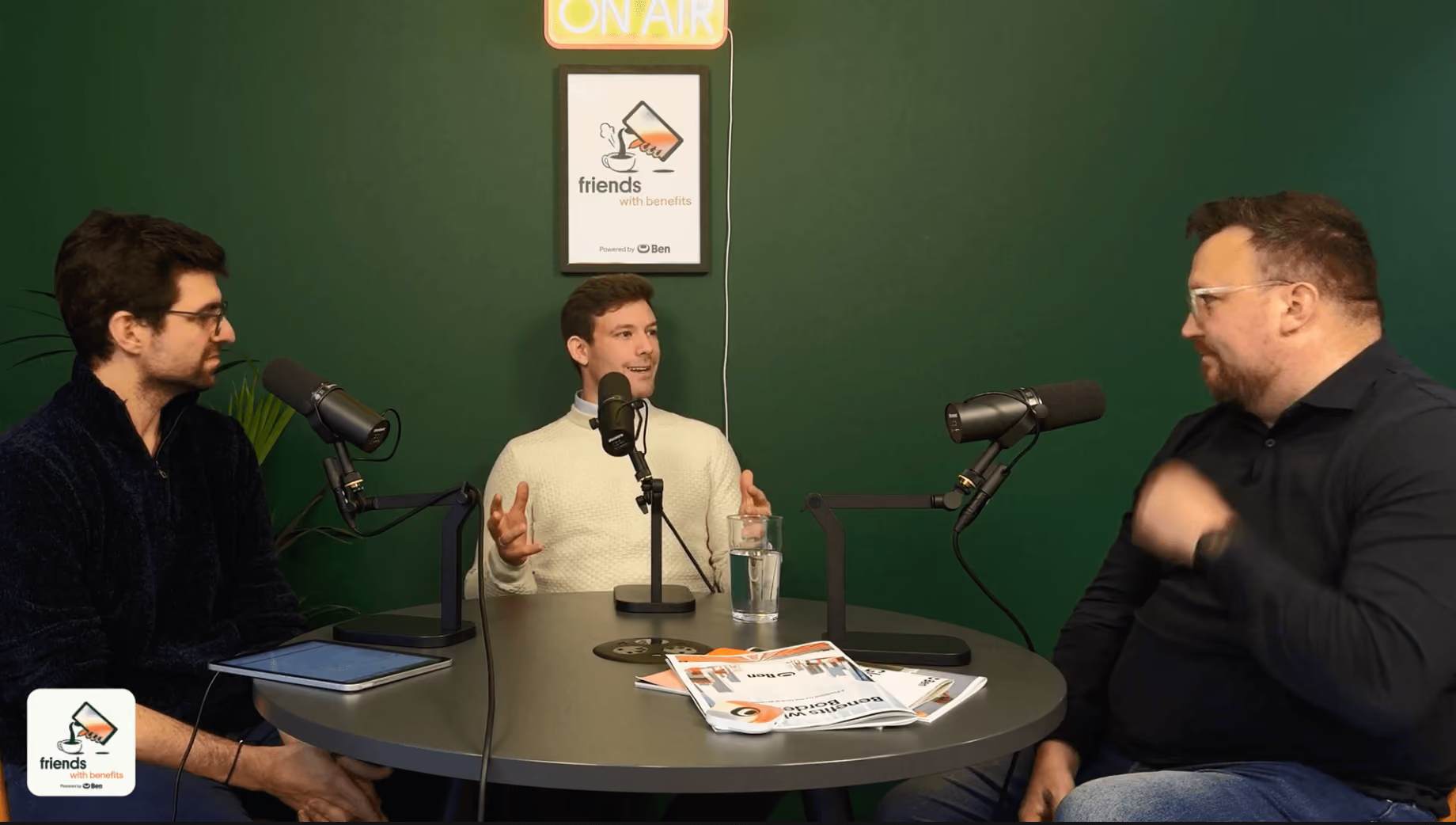
Dino Bertolis, founder of CycleSaver, has spent a decade testing that assumption, first at Discovery and Vitality, now with his own cycle-to-work business. His conclusion runs against most of the industry's instincts.
"If you give something for free to everyone without any effort, the utilisation of that is not as good as something that requires even a small amount of effort," he said on the Friends With Benefits podcast.
Remove every barrier, and people often engage with a benefit less, not more.
The reward that people didn't earn
Dino's team at Vitality tested this directly. They offered rewards that required no action at all, and rewards that asked people to do something small first.
The version with a small amount of effort attached won every time. "People felt that they earned that reward," Dino said. "It was theirs, and they deserved it."
The free version had no such pull. There was nothing to feel good about claiming, because there was nothing to claim. Carl Chapman, Ben's VP of Benefit Design and Partnerships, put the pattern plainly on the episode: benefits leaders give people amazing things for free, then wonder why nobody uses them.
The problem isn't generosity, it's that a benefit with no effort attached doesn't feel like it belongs to anyone.
Deadlines change behaviour more than incentives do
The second pattern Dino has tested repeatedly is timing. Rewards that accrue whenever someone gets round to it perform worse than rewards tied to a deadline.
"You can't even compare how much better the time-bound rewards were," he said. Asking someone to hit a target within a week, rather than whenever they feel like it, changes what they actually do. Left open-ended, most people wait.
Dino's comparison was a gym membership: tell someone to go ten times and there's always tomorrow. Tell them to go three times this week and the pressure works.
It's the same instinct that makes benefits enrolment windows effective, and the same instinct the industry has been designing out.
Reward and benefits teams have spent years pushing toward always-on, any-time benefits, on the reasonable logic that flexibility helps people. Carl raised the tension directly on the episode: an always-on benefit removes the one thing that gets people to act, which is a deadline. Inertia fills the gap instead.
Where the line sits
None of this is an argument for making benefits difficult. Dino was clear that too much friction kills a reward just as effectively as none at all. Multi-step sign-up processes, codes to redeem, forms to fill in before a discount applies.
He's watched rewards fail for exactly that reason. "It just becomes too much," he said. "You want to make it as simple as possible for people to get involved."
The distinction that matters is between friction that's there for a reason and friction that's just clutter. A deadline or a small task that makes a benefit feel earned is doing something. A five-step redemption process is doing nothing except costing you the person who gave up on step three.
CycleSaver's own model reflects the same thinking. Salary sacrifice already requires an active choice from the employee, which is arguably the point. It isn't the zero-effort, take-it-or-leave-it version of a benefit. It's a deliberate decision to save up to 47% on a bike-share subscription, which may be part of why it converts better than a benefit that costs nothing and asks for nothing in return.
Why this matters
Most benefits strategy still starts from a single question: how do we remove the barrier? It's a reasonable question, and often the right one. But it isn't the only question worth asking.
Dino's experience across two very different products, insurance rewards and bike-share subscriptions, points to a second question that gets asked far less often: does this benefit feel earned? A programme with genuinely no take-up isn't always failing because it's too hard to access. Sometimes it's failing because there's nothing to feel good about accessing.
The fix isn't more friction for its own sake. It's the right amount, placed deliberately, so that using a benefit feels like something a person chose to do rather than something that happened to them.
Watch the full Friends With Benefits episode with Dino Bertolis

.avif)