.avif)
⋅ X min read
Chatbots for employees aren't anything new. They were the first thing anyone saw when AI turned up in benefits: a little widget bolted onto an employee portal, answering "how many holiday days do I have left" or "when does enrolment close."
Most companies have already tried one, and most employees have been underwhelmed by it.
This Is What “AI-Native” Actually Means for Employee Benefits
Chatbots were the easy part
That's not a coincidence. A basic Q&A chatbot is the first thing you'd build with AI on a benefits platform, because it's the least the platform has to give it. Point a model at a policy document and it can answer questions about the document. That's useful once, but it doesn't take long to run out of road.
The numbers on this aren't guesswork. WTW's research puts employee understanding of their own health and wellbeing benefits at 44%, and satisfaction with benefit offerings has actually fallen over the past year, from 66% to 61%.
We know companies aren't short on benefits. They're short on employees who know what they've got, and a chatbot that can only describe the catalogue doesn't fix that. It just makes the catalogue searchable.
The problem is what a chatbot can't do
Most of what employees get, chatbot or not, is a slightly smarter version of the same static list: every benefit, every policy, presented the same way to everyone. Same page for someone who joined last week. Same page for someone who's about to have a baby. That's not personalisation.
You already know this matters. And the data agrees with you. Voya's research found that 49% of employees say personalised benefit recommendations would increase their confidence in making benefits decisions, and employees who get personalised guidance are nearly twice as likely to feel prepared for retirement, 81% versus 47%.
Personalisation isn't a nice-to-have layered on top of the real product. For a lot of employees, it's the difference between using a benefit and not knowing it applies to them.
What's different when the platform actually knows the employee
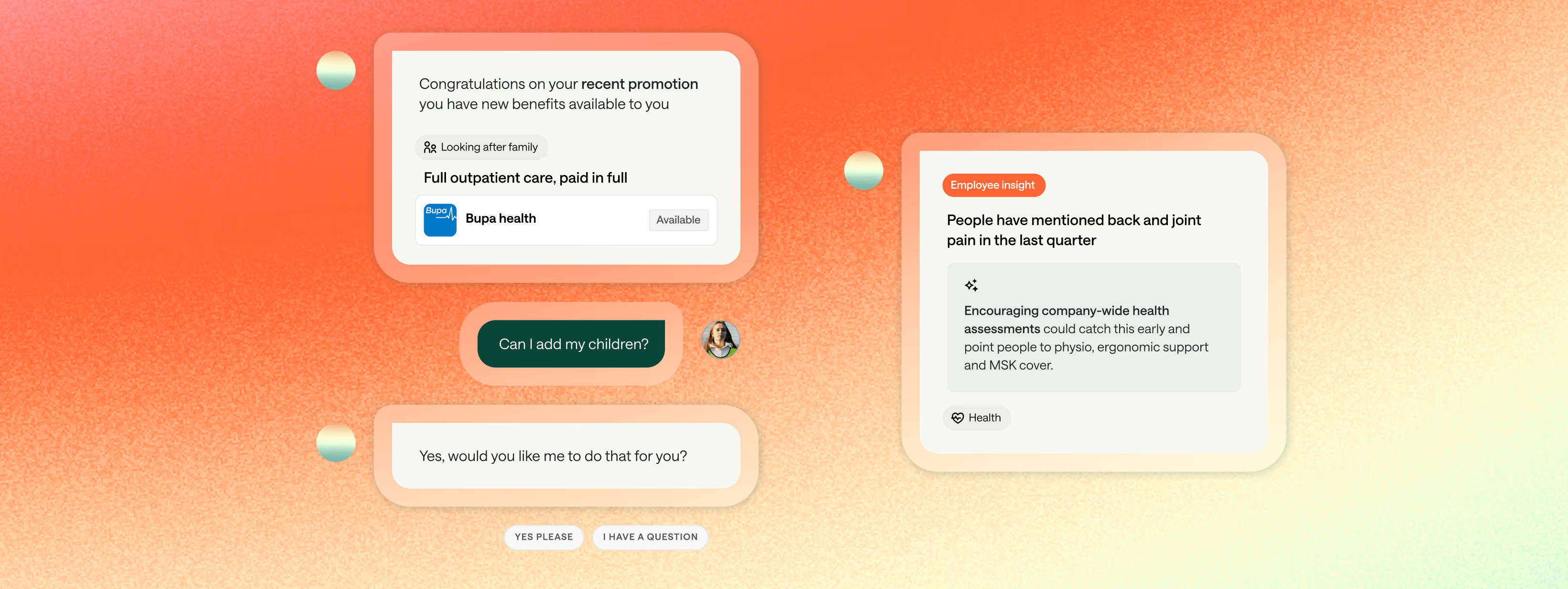
Ben's context layer holds more than policy documents. It holds the record of how a company's benefits actually work, and what's happening for each employee inside that: their circumstances, their life events, their enrolment windows, what they've already engaged with and what they haven't.
Take an employee who's just found out they're expecting. On most platforms, nothing changes. They'd have to go looking for the parental leave policy themselves, probably find it in the same static list as gym membership and dental cover, and work out what applies to them on their own.
With the context layer, the platform already knows something's changed the moment the life event is logged. Their homepage updates to surface parental leave and any related allowance before they've had to ask. That's the shift: from a platform that waits to be searched to one that notices.
In practice, across the experience, that looks like:
- A homepage that reflects an employee's actual circumstances, not a static list of everything on offer.
- Intent detection tied to real triggers, a life event, a lapsing allowance, an enrolment window opening, reshaping what someone sees the moment it becomes relevant, not the next time they happen to log in.
- Multi-prompt, agentic search that understands a real question, rather than matching keywords against a policy document and hoping for the best.
- A conversational onboarding flow built around what someone actually says matters to them, not just their location, age or role.
None of this is what the first wave of benefits chatbots were built to do. They answered questions. This notices things and acts on them.
It changes what a Reward leader can do, too
The same context layer that personalises what an employee sees also does something for the person running the programme. A campaign builder and goal-setting tools let AI write the message itself, and increasingly work out who should get it and when, based on what the platform already knows rather than a brief someone has to write first.
That's the closest thing to having a marketing team inside a benefits team without having to hire one.
And it changes what Ben's team can see, too
Context tooling and comms visibility, governed by the same role-based access and audit logging as everything else on the platform, let Ben's team see exactly what's actually gone out to your employees, and why.
When something needs checking, that's the difference between a fast, informed answer and Ben's team working from guesswork about what an employee actually saw.
It's a smaller point than the employee-facing changes, but it's part of the same architecture doing its job in the background.
Why this is worth the scepticism, and worth getting past it
If a company's already tried a benefits chatbot and found it underwhelming, that's a reasonable thing to be sceptical about. It just isn't a reason to write this off. The chatbot wasn't wrong to try. It never had anything real to work with beyond a policy document and a search bar.
The case for fixing that isn't a hunch. Employees who get personalised guidance are close to twice as likely to feel prepared for the decisions in front of them. That's not a small gap, and it's not one a static catalogue, or a chatbot bolted onto one, was ever going to close.
.avif)
.avif)