
⋅ X min read
Benefits implementation has a credibility problem.
For many global HR and Reward leaders, switching platform is not a strategic conversation, it's a risk calculation. Time, payroll exposure, internal bandwidth, reputational impact — these are the variables that matter.
The anxiety is understandable. Much of it's rooted in experience. Legacy providers have trained the market to expect long timelines, heavy customisation, opaque testing cycles and post-launch instability.
But most implementation risk is not inherent, it’s structural.
The difference lies in how the platform is built — and how the implementation process is governed.
Let’s separate assumption from reality.
Myth 1: “Implementation will take too long”
The assumption is that benefits implementation is, by default, a multi-month disruption.
In practice, duration is rarely driven by configuration complexity alone. it's driven by governance.
Where requirements are ambiguous, stakeholder ownership is unclear, and decisions are revisited mid-build, timelines expand. Where requirements are structured, signed off, and treated as fixed inputs, implementation becomes predictable.
At Ben, implementation follows a defined four-stage workflow: structured requirements gathering, controlled platform build, internally validated UAT, and hypercare.
Requirements are not captured informally. They are documented and governed through the Benefit Design Tracker, which becomes the single source of truth across countries.
.avif)
For complex, multi-stakeholder programmes, AI-assisted workflows translate policy documents and stakeholder inputs into structured outputs ready for build. This reduces ambiguity before configuration begins.
.avif)
Once requirements are locked, the variable becomes internal responsiveness — not platform capability.
In aligned organisations, multi-country launches can move quickly. Where internal approvals stall, implementation reflects that reality.
Speed is therefore not a product promise, it’s the outcome of structured governance.
Myth 2: “Testing will drag on forever”
Testing becomes prolonged when it's treated as discovery rather than validation.
In many legacy implementations, UAT is the first time the customer truly sees how eligibility, pricing logic and payroll outputs behave at scale. Predictably, issues surface late. Iteration cycles multiply.
At Ben, UAT is confirmatory, not exploratory.
Before customer testing begins, every benefit's validated internally against locked requirements. Build outputs are compared directly to the agreed design.
Configurations are assessed against an internal QA framework before release.
Eligibility and pricing are stress-tested using two complementary approaches:
- Real client data where available
- Synthetic datasets generated to increase permutation and edge-case coverage
Payroll outputs are reconciled against known baselines wherever possible.
Issues are categorised by severity and resolved before formal customer UAT begins.
By the time customer UAT starts, the objective is confirmation — not discovery of structural defects.
Testing does not drag on when it's built on controlled inputs and internal validation.
Myth 3: “Configuring something new means custom development”
Enterprise buyers often equate “new configuration” with bespoke engineering.
That assumption comes from platforms built around one-off customer setups.
Ben’s architecture is modular.
Benefits are constructed from reusable components — eligibility logic, contribution tiers, pricing formulas, enrolment rules — assembled within a governed configuration framework.
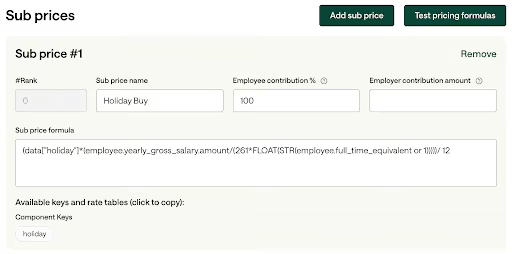
Pricing logic is structured and validated before being saved, protecting financial accuracy at scale.
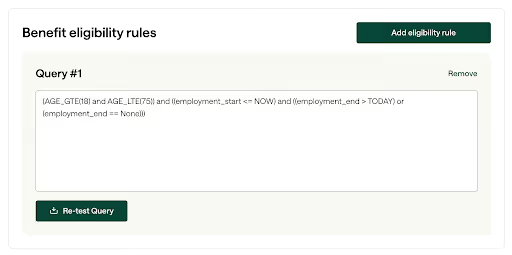
Complex eligibility rules can be configured to reflect workforce nuance without requiring fragile, one-off builds.
Where automation accelerates configuration — such as AI-led document interpretation — it operates under human oversight.
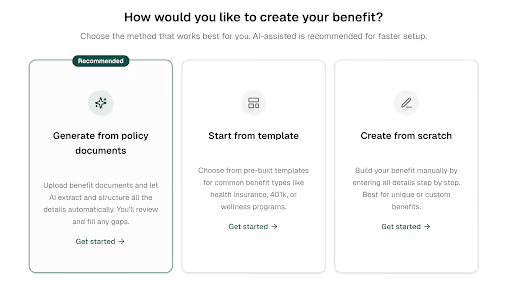
For benefits that require additional complexity, AI can assist internal alignment while final validation remains controlled.
Configuration is not bespoke engineering. it's structured assembly within a governed system.
That distinction determines whether a platform scales cleanly — or accumulates operational debt.
Myth 4: “All benefits platforms are the same under the hood”
From the outside, platforms may appear similar.
Employees enrol. Payroll files generate. Dashboards display. The differences emerge under pressure.
Legacy systems are slow because they were designed around bespoke builds and rigid architecture. Even minor changes require engineering intervention. Iterations carry risk.
Platforms designed around modular components and internal validation behave differently. They allow change without destabilisation. They support multi-country complexity without multiplying custom logic.
The distinction becomes visible during implementation — particularly in eligibility edge cases, pricing reconciliation, and payroll validation.
Infrastructure matters more than interface.
The real issue
Implementation anxiety is rarely about configuration screens, it's about exposure.
Exposure to payroll error. Exposure to eligibility misalignment. Exposure to post-launch instability.
When implementation is governed through:
- Locked requirements
- Modular build architecture
- Internal QA validation
- Structured UAT with real and synthetic data
- Controlled hypercare
— it stops being an unpredictable phase and becomes a managed risk environment.
How implementation works at Ben
Implementation at Ben is structured to prevent downstream failure.
It begins with governed requirements capture. Each benefit, by country, is documented in a locked tracker. Conflicting inputs are resolved through steering governance before build proceeds.
The platform build stage is controlled through modular configuration, with benefits released incrementally and tracked against clear success metrics.
- Before UAT, internal QA validates configuration against requirements. Eligibility matrices and pricing reports provide full visibility into outputs across the workforce.
- Customer UAT is then conducted within a defined framework, with clear ownership of synthetic data creation, issue categorisation, and resolution thresholds.
- Post-launch, hypercare is time-bound and structured. Ticket themes are monitored, payroll runs validated, and escalation paths predefined.
- Stability is measured through SLAs, resolution performance, payroll accuracy, and reduction in recurring issues.
Implementation is therefore not a leap of faith. It's a controlled sequence designed to ensure that what was designed is what operates — across eligibility, pricing, payroll and reporting.
If implementation is where most platforms expose their limitations, it's also where structural quality becomes evident.
The most reliable way to assess that quality is to see it working live — against real requirements, real edge cases, and real payroll outputs.